Supplying parts to customer specifications. ZERO DEFECTS
Mitutoyo Coordinate Measuring Machine
Unleashing Precision
Premier Die Casting and Plastic Injection Services
Milling and drilling machine working process High precision CNC in the metalworking plant, working process in the steel industry.
Unleashing Precision
Premier Die Casting and Plastic Injection Services
High-speed drill.
Unleashing Precision
Premier Die Casting and Plastic Injection Services

Positive Material Identification

Electroplating

Tool Frabrication

CNC Machining

3D Printing

Surface Finishing

Plastic Injection Moulding

Precision Aluminium Die Casting

Precision Zinc Die Casting

Ssoss Cast is a leading global provider of zinc and aluminum alloy die casting, with manufacturing in China and headquarters in Singapore

Precision Die Casting Excellence Since 1995

With over 30 years of manufacturing expertise, SSOSS Cast has been delivering precision die casting solutions since 1995. Our strategic dual-location setup combines Singapore’s business excellence as our global coordination hub with China’s manufacturing efficiency from our advanced facility just 60 kilometers from Xiamen International Airport and Container Port. 

Partnering With SSOSS

With SSOSS Cast, you gain access to a comprehensive, one-stop solution led by experienced engineers who understand precision manufacturing complexities.

Award-Winning Excellence

ISO Standards and Business Excellence models serve complementary roles in Ssoss quality management.

Commitment to Quality

We adhere to strict quality principles, superior performance and reliability in all our products.

Medical

Lorem ipsum dolor sit amet, consectetur adipiscing elit

Optical

Lorem ipsum dolor sit amet consectetur adipiscing elit

Semi Conductor

Lorem ipsum dolor sit amet consectetur adipiscing elit

Telecommunication

Lorem ipsum dolor sit amet consectetur adipiscing elit

Low MOQ Possibility

Low Minimum Order Quantities possibilities (MOQs) enable our customers to minimize financial risk through smaller upfront investments while maintaining flexibility to adapt to market changes. This approach is particularly valuable for startups, small businesses, and companies testing new products or entering uncertain markets where rapid response to trends is essential.

Prototyping

Transforming a product concept into a tangible form, ranging from simple sketches to functional physical models.

Engineering design verification and testing (EVT+DVT)

Engineering Validation Test (EVT) with prototype to mimics final design functionality while our Design Validation Test, (DVT) aims to test the product manufacturability.

Production Validation andTesting (PVT)

Production Validation Testing (PVT), the final pre-production phase, uses finalised tooling and validated equipment to optimize manufacturing processes, worker efficiency, and yield rates before mass production launch.

Mass Production (MP)

Mass Production (MP) represents the final stage of product maturity, beginning with a minimum production run of 3,000 units and potentially scaling to millions while maintaining consistent quality across all units produced.

We have both local and overseas sourcing teams working closely with manufacturers that have a proven track record of making high-quality parts.

Request A Qoute

Lorem ipsum dolor sit amet, consectetur adipiscing elit. Ut elit tellus, luctus nec ullamcorper mattis, pulvinar dapibus leo.
Max 100MB/file, Support: pdf, dwg, dxf, drw, iges, igs, ipt, jpg, jpeg, jt, step, stp, stl, sat, sldasm, sldprt, slddrw, png, svg, x_t, x_b, 3dxml, 3mf, zip… If your file is not supported, please compress it into zip and upload

Why Zinc Die Casting Beats Plastic and Aluminium for High Precision Parts

Many product teams start with plastic because the quote looks friendly. Then the field failures show up. You see warping under heat. You see cracking after UV exposure. You see assembly drift that turns a clean CAD model into a rework party.

At SSOSS Cast, we see this pattern most often in electronics housings, connector parts, small mechanical linkages, and hardware that gets handled every day. The part looks small. The tolerance stack is not.

Why choose zinc die casting instead of plastic injection or aluminium die casting?

[Answer Capsule] Zinc die casting is a strong choice when you need repeatable tolerances, thin walls, and a premium surface finish at medium to high volume. Typical zinc tooling can reach around 1,000,000 shots, often more in well managed programs. Zinc’s low melting point supports faster cycles than aluminium in many applications. Plastic can win on unit cost, but it is more exposed to UV and heat driven degradation risks in real world use. (Zinc Die Casting)

Zinc is not for every part. If your top priority is ultra light weight, aluminium or engineered plastics may fit better. If your top priority is tight tolerance stability, crisp details, and a strong “click feel,” zinc usually becomes the safer bet.
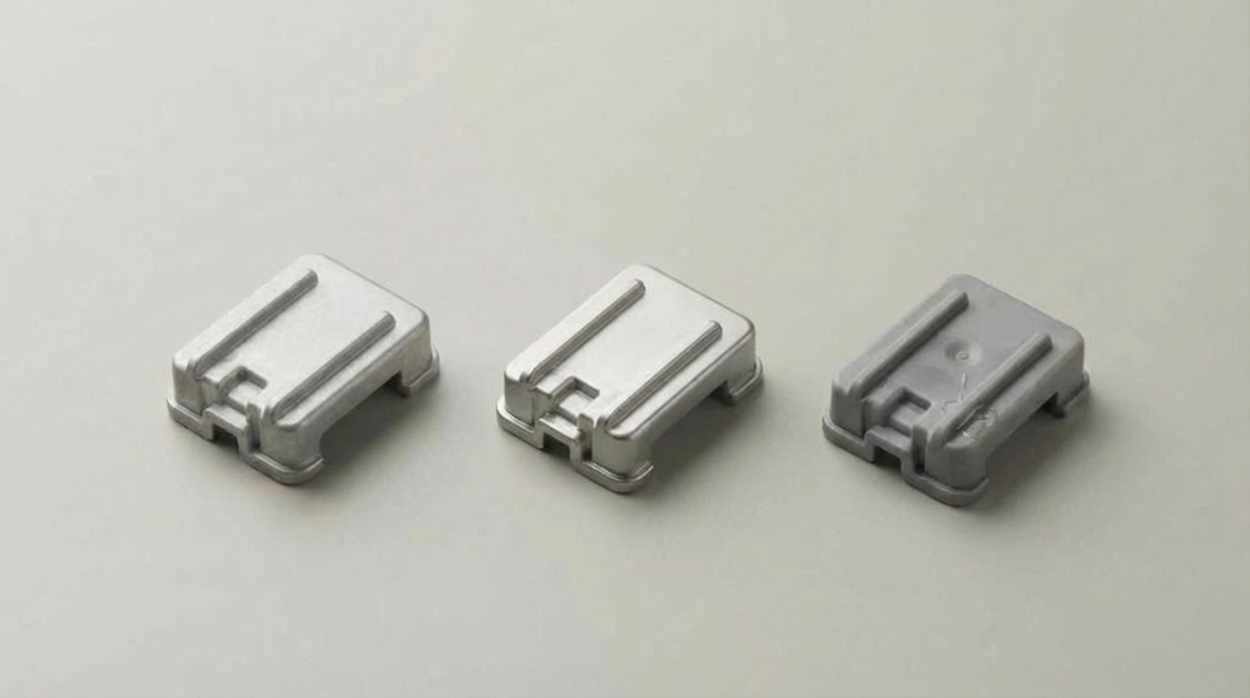
Why Zinc Wins for Precision Parts

Quick comparison table for decision makers

Criteria Zinc die casting Aluminium die casting Plastic injection moulding
Typical tooling life (well managed) Often around 1,000,000 shots Often lower than zinc in many programs Can be high, depends on resin and tool steel
Thin wall capability Often feasible around 0.5 mm with good design Often needs thicker walls depending on part Thin walls possible, but risk of sink and warpage rises with geometry
Cycle speed Often faster due to lower melt temp Often slower due to higher melt temp Fast, but depends on cooling and gate design
Surface finish Excellent, plating friendly Good, often needs finishing for premium feel Can look great, but cosmetic defects are common
Field risk in tropical UV and heat Low compared to many plastics Low Higher, material dependent, UV can embrittle polymers over time

Tooling life and wall thickness are design dependent. Use them as planning ranges, not promises. (Deco Products)


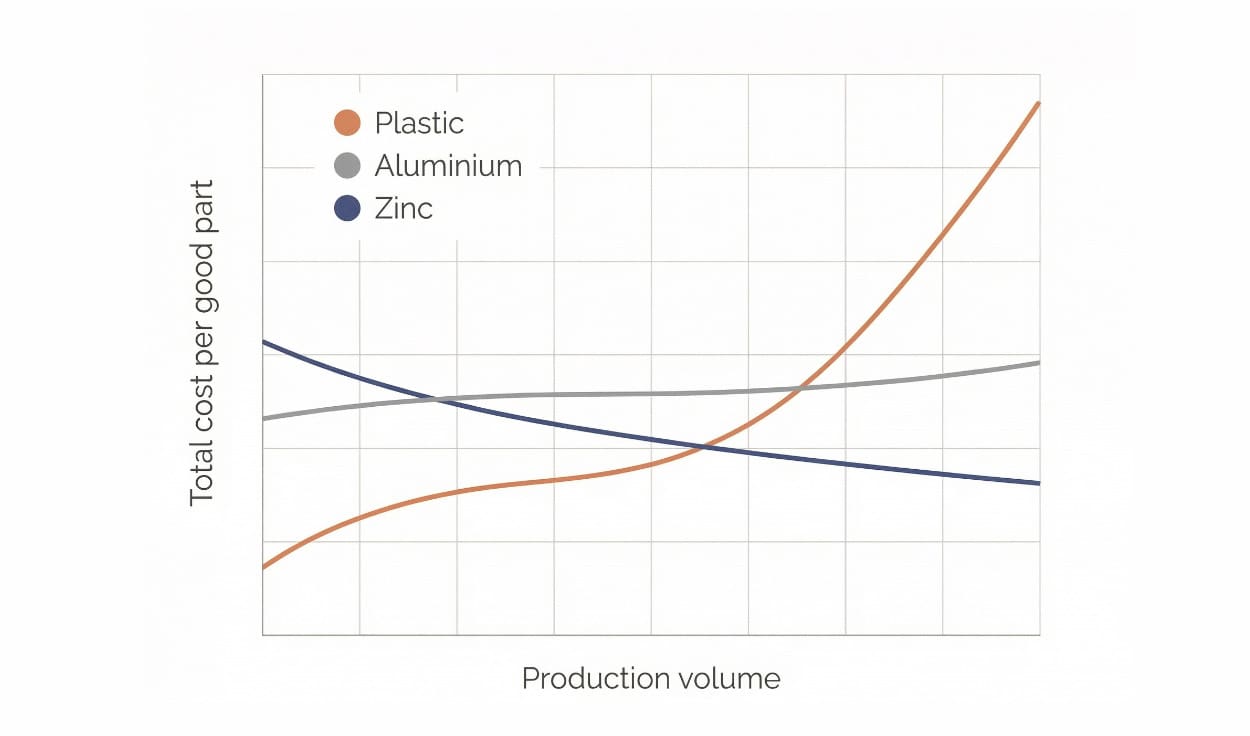
When does zinc become more cost effective than aluminium?

Aluminium is often chosen by habit. The problem is that “material choice” is not only weight and strength. It drives cycle time, defect risk, tool wear, and how much machining you need.

Zinc melts at about 419°C, which is much lower than aluminium. That lower process temperature is one reason zinc can run faster and preserve tooling better in many production environments. (DeZe Technology Co, Ltd)

A practical way to think about break even is this.

Break even logic that actually matches factory reality

Zinc becomes more cost effective when at least one of these is true:

  1. You need thin walls and tight tolerances, so aluminium would need extra machining to “save” the part.
  2. You want to avoid frequent tool refurbishment and downtime.
  3. Your program is medium to high volume and the cycle time difference matters.

Many industry references point to zinc tooling life around 1,000,000 shots as a typical range, with real examples going higher. Aluminium dies are often quoted at much lower shot counts depending on alloy, part design, and die management. (Zinc Die Casting – German)

SSOSS Cast also shares a case where an aluminium RF housing needed a full secondary CNC pass and had scrap issues around thin ribs. After changes, scrap dropped and machining was removed. That is often where the real money is. Not “metal cost,” but avoided rework. (SSOSS Cast Pte Ltd)
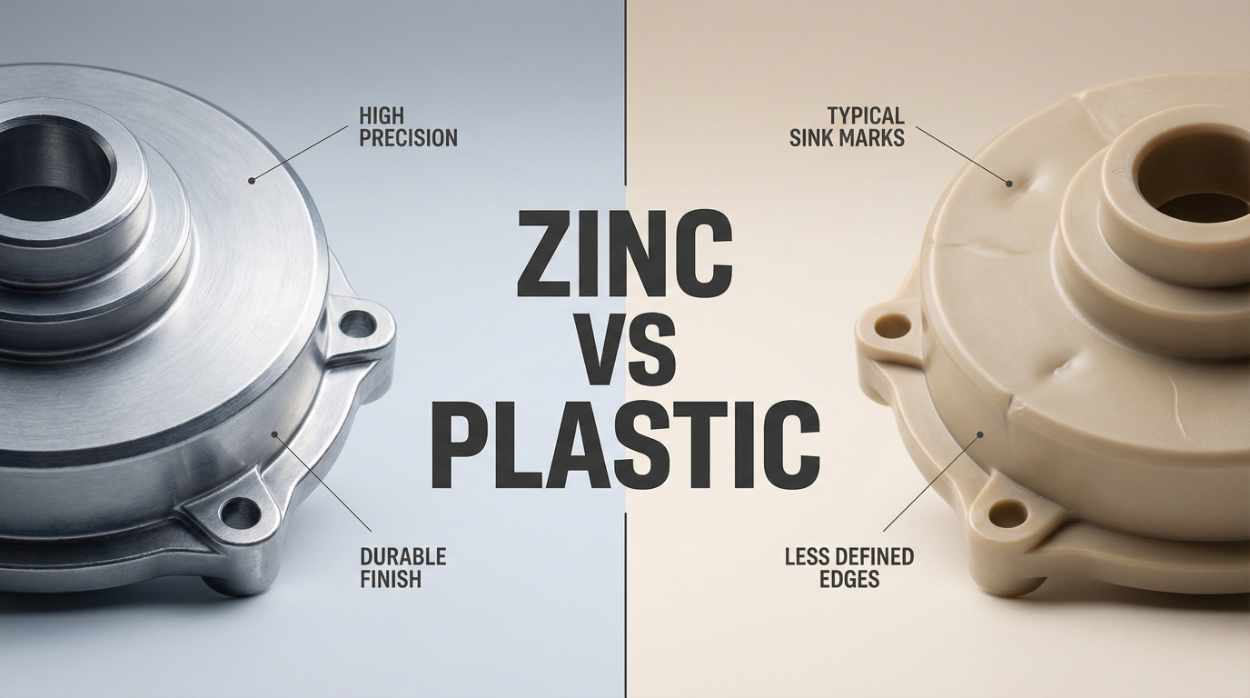
zinc vs plastic injection molding


Can zinc fix common plastic injection moulding problems?
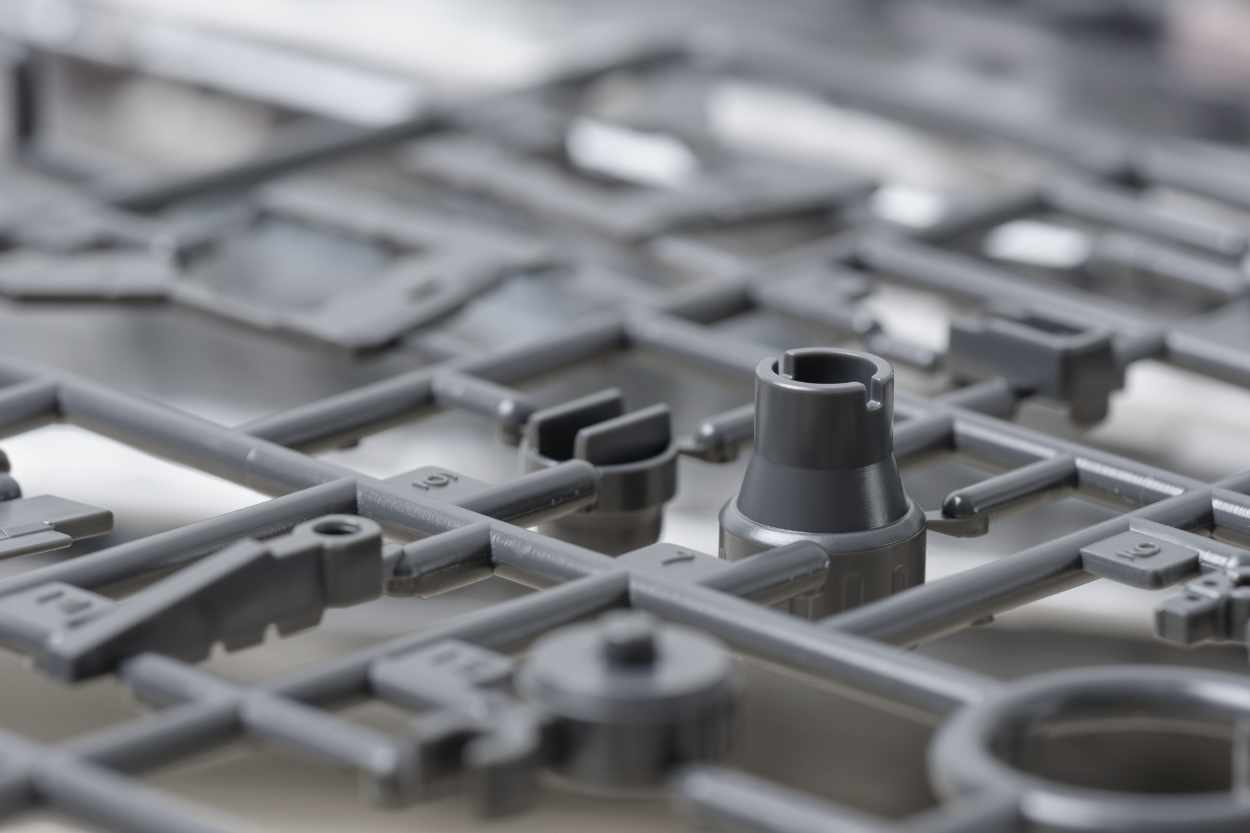
zinc vs plastic injection molding
closeup sprue or injection moulding of toy

Plastic can be excellent when it is designed correctly and the resin is matched to the environment. The failures we see usually happen when a plastic part is doing a metal job.

1) UV and weather driven embrittlement

UV radiation can cause photo oxidative degradation in polymers, which reduces mechanical properties and can lead to cracking and brittleness over time. This is not a Singapore only problem. Singapore’s sun and heat simply make bad material choices show up faster. (PMC)

2) Creep and “loss of clamp” feel

Many plastics are viscoelastic. Under long term load, they can creep. Temperature and humidity can accelerate creep effects depending on polymer system and design. That matters for clips, latches, and parts that must keep a precise feel over thousands of cycles. (PMC)

3) Sink marks and cosmetic quality drift

Sink marks are a common injection moulding defect. They often happen around thicker sections where cooling and shrinkage are uneven. If your product is consumer facing, this can damage perceived quality even when function is fine. (Fictiv)

Zinc avoids these specific plastic failure modes. You still need proper DFM, gating, and draft. You just remove the polymer physics risk that shows up in harsh use.
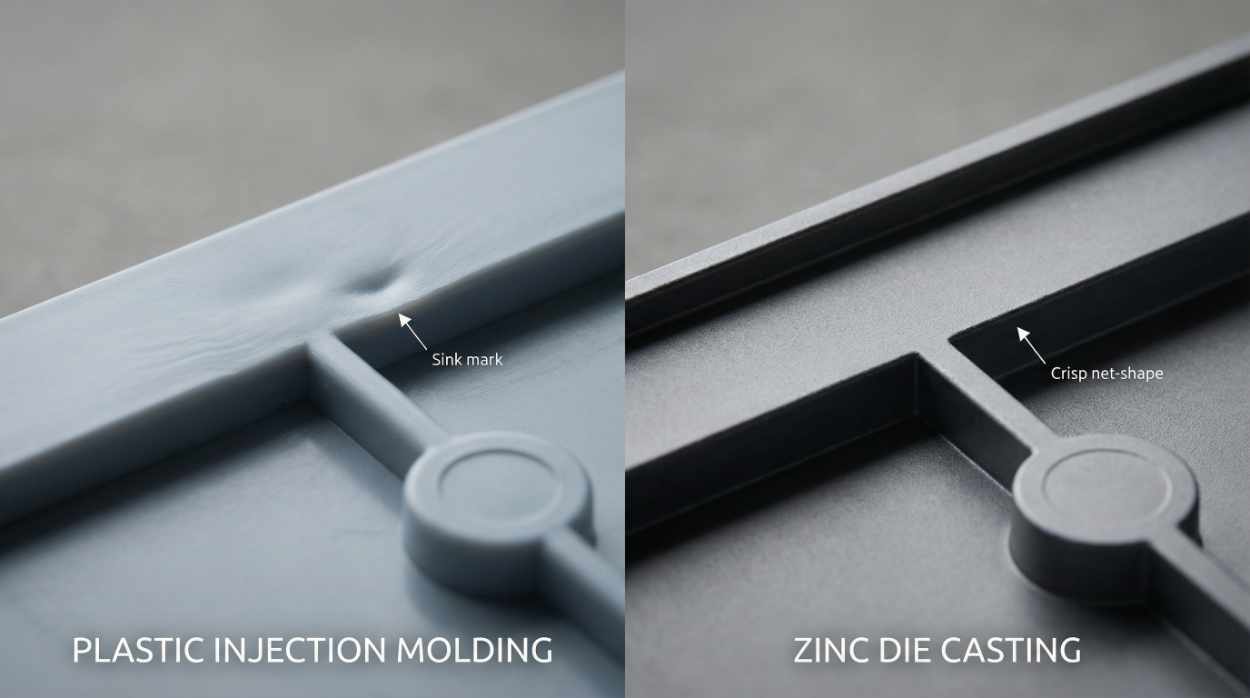
Zinc vs Plastic Injection Molding: Why Zinc Wins for Precision Parts


How thin can zinc die casting go for small precision parts?

Thin walls matter for two reasons. They reduce material. They also reduce cycle time.

Industry guidance commonly cites 0.5 mm to 1.0 mm as a practical minimum range depending on design, geometry, and strength requirements. Zinc industry design rules also discuss minimum practical wall sections that can go below 0.5 mm in short flow distances with the right gating strategy. (Dynacast)

SSOSS Cast highlights zinc alloy die casting for thin walls and intricate details. Their “About Die Casting” page also references Zamak 3 and why it is widely used for tight tolerances and good finishing acceptance. (SSOSS Cast Pte Ltd)

If you want a fast DFM check before cutting steel, use these three questions:

  1. Are wall thicknesses consistent, or do they jump abruptly?
  2. Are ribs sized to support, not to create hot spots?
  3. Is draft included everywhere the die needs release?
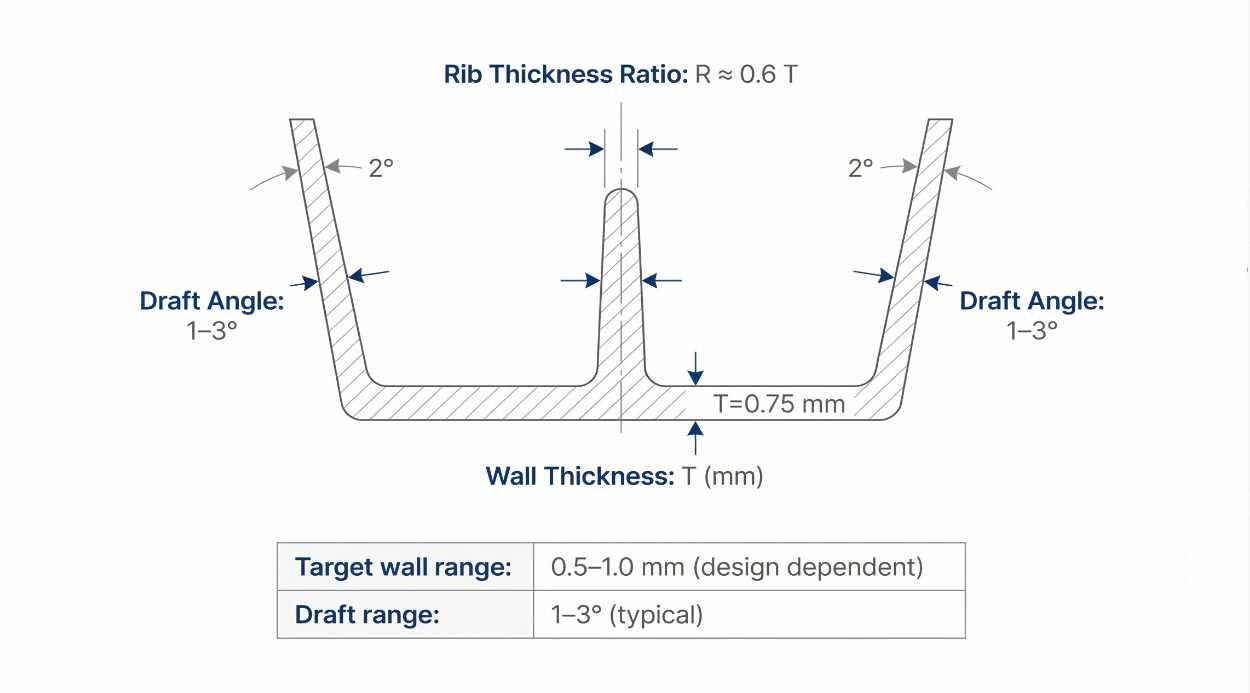
Why Zinc Wins for Precision Parts


How SSOSS Cast supports faster production without sacrificing precision
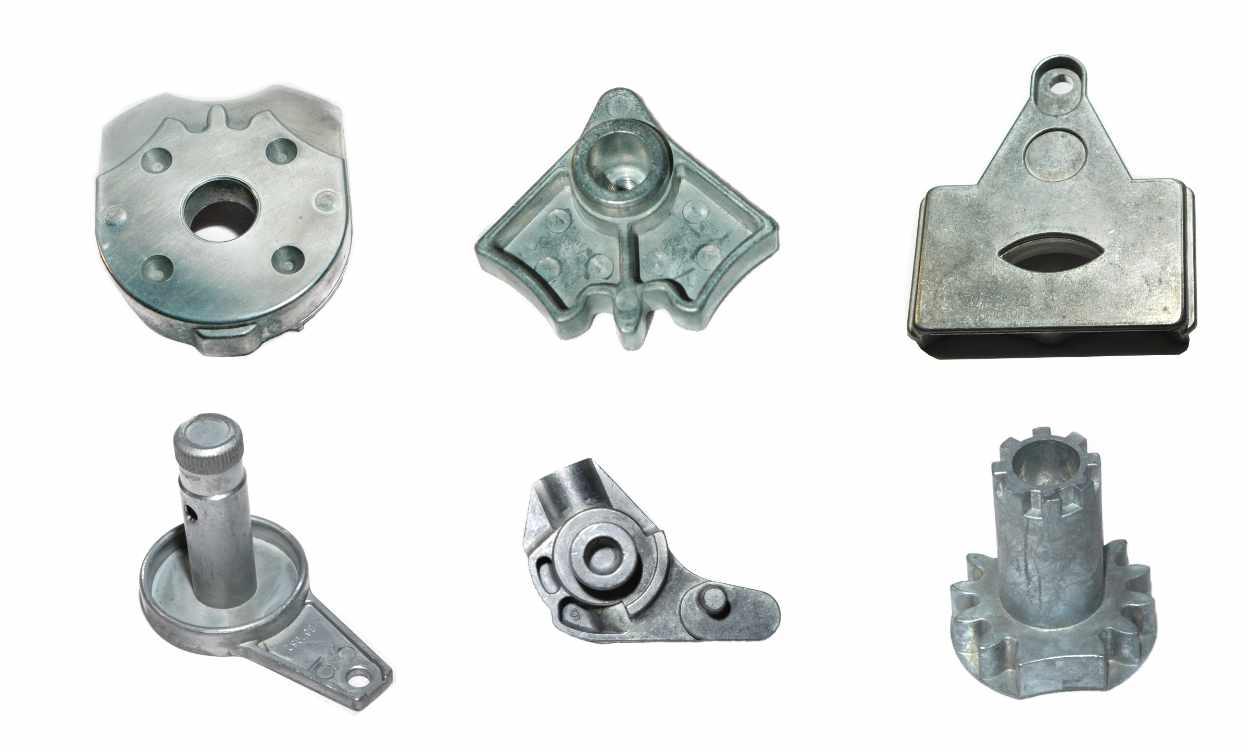
zinc vs plastic injection molding

A big pain point for Singapore OEM teams is coordination. The CAD team is here. The factory is elsewhere. The revision cycles get slow.

SSOSS Cast positions Singapore as the coordination hub and runs manufacturing from a facility near Xiamen, with their site describing the dual location setup and logistics advantage. (SSOSS Cast Pte Ltd)

They also highlight capabilities for larger precision zinc die castings up to 2.8 kg per shot while holding tight tolerances. That matters for programs that grow beyond tiny parts. (SSOSS Cast Pte Ltd)

A practical lead time mindset

Instead of asking “how fast is the first sample,” ask these:

  1. How fast can the supplier run design review and DFM feedback?
  2. How fast can they stabilize the process so your second batch matches the first?
  3. How fast can they add finishing and secondary operations without quality drift?

SSOSS Cast emphasizes a DFM led process flow and shares a case study framing that design review often prevents weeks of defect chasing later. (SSOSS Cast Pte Ltd)
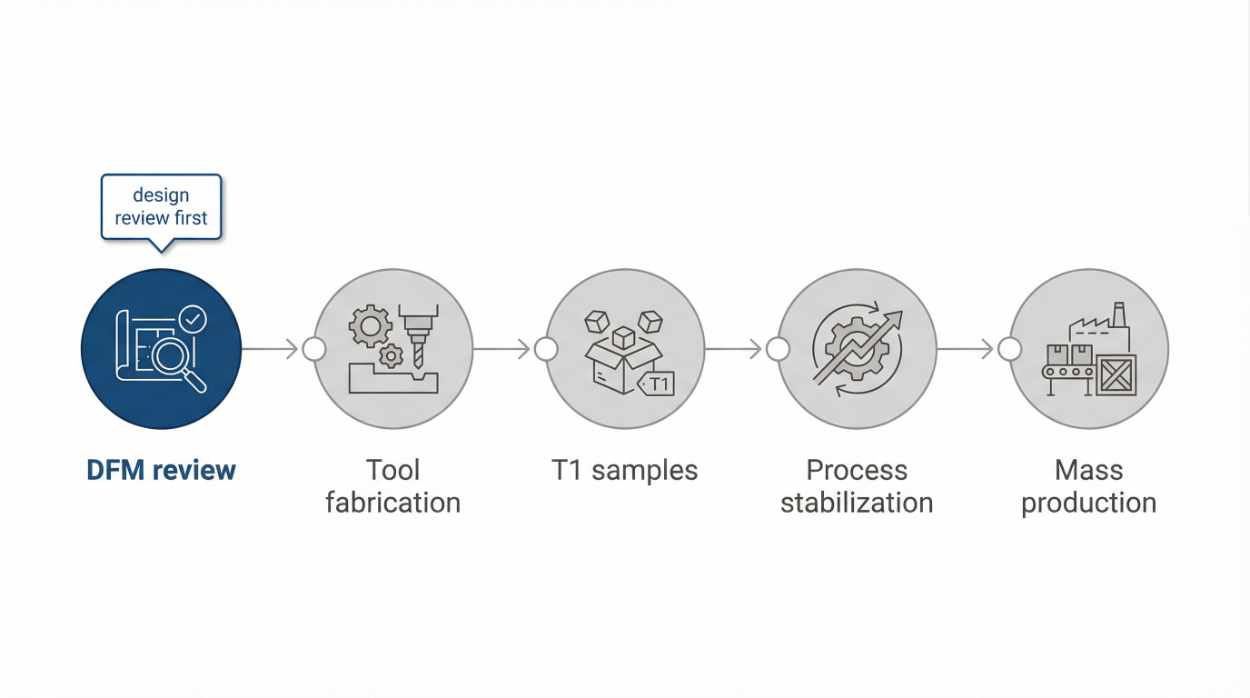
Zinc vs Plastic Injection Molding


Surface finishing that makes zinc look premium

Zinc is popular for parts that need both precision and a premium look. It accepts a wide range of finishes.

SSOSS Cast offers surface finishing and electroplating as part of their service stack, and they show product categories like chrome plated zinc die casting. (SSOSS Cast Pte Ltd)

Common finish goals we see:

  • Chrome plating for high gloss, premium hardware and visible components.
  • Powder coating for durability and color stability.
  • Raw tumbled finish for functional parts where appearance is secondary.

If your product is customer facing, finishing is not decoration. It is part of quality perception and sometimes corrosion behavior.
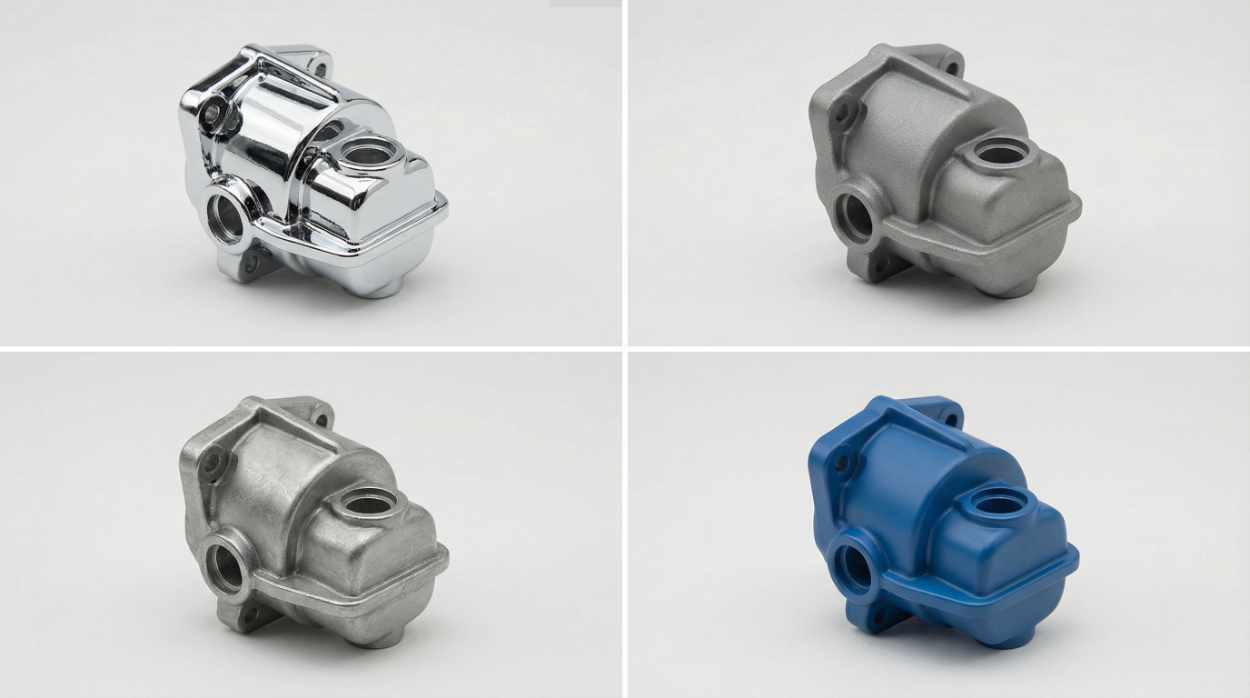
Zinc vs Plastic Injection Molding


A simple buyer checklist for choosing zinc vs plastic vs aluminium

If you are an SME director or operations manager, you do not want theory. You want fewer defects and stable supply.

Use this checklist before you commit.

Choose zinc die casting when

  1. You need repeatable dimensions in production, not only on the first sample.
  2. You need thin walls, sharp edges, and crisp features.
  3. You want to reduce machining and assembly rework.
  4. The part is handled often and “feel” matters.

Choose aluminium die casting when

  1. Weight is critical.
  2. The part is larger and structural, and wall thickness is not ultra thin.
  3. You can tolerate more machining or you already have a stable aluminium process.

Choose plastic injection moulding when

  1. Weight is critical and loads are low.
  2. You can select a resin that survives heat and UV exposure for your actual use case.
  3. Cosmetic defects and creep are managed by design and process control.
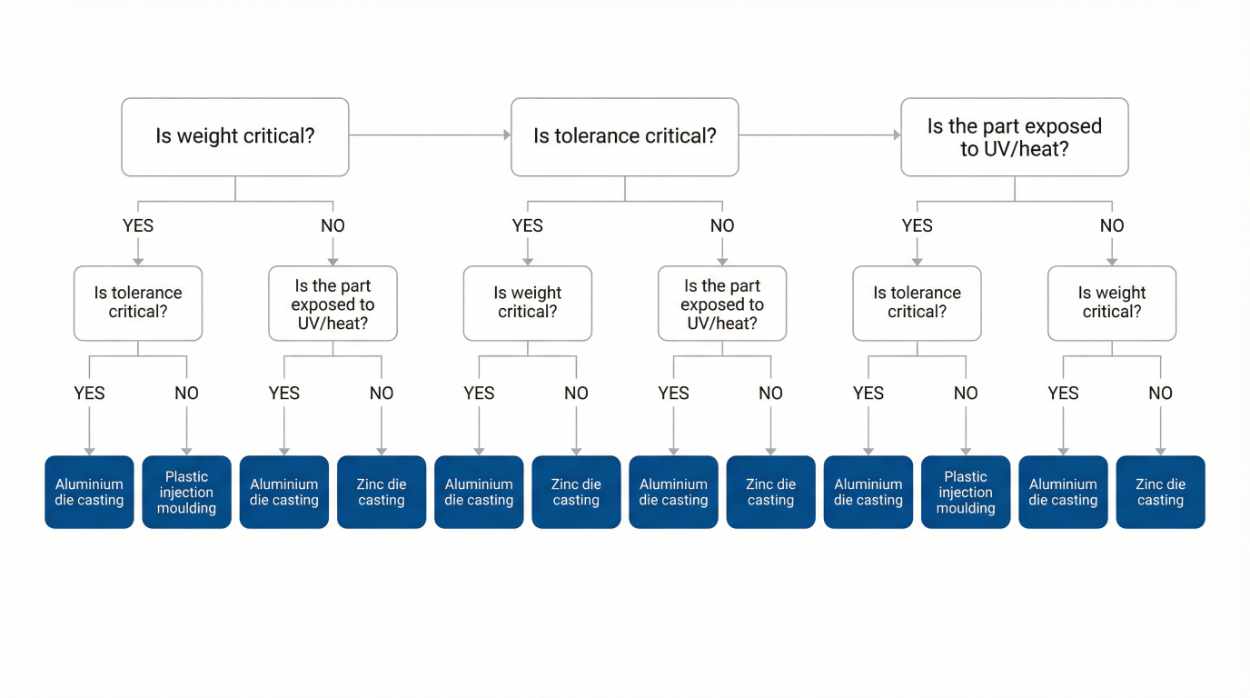
Zinc vs Plastic Injection Molding: Why Zinc Wins for Precision Parts


FAQ

What zinc alloy is commonly used for high precision parts?

Zamak 3 is widely used. SSOSS Cast states it is a popular zinc alloy and notes its strength, ductility, castability, and tight tolerances among zinc alloys. (SSOSS Cast Pte Ltd)

What is a realistic tooling life expectation for zinc?

Many industry sources cite around 1,000,000 shots as a typical die life range for zinc tooling, with examples exceeding that under good conditions. Your actual result depends on part design, die design, and maintenance discipline. (Zinc Die Casting – German)

How fast is zinc die casting compared to aluminium?

Zinc’s lower melting point supports faster processing in many scenarios. Some manufacturing references describe zinc cycle rate as about 150% to 200% higher than aluminium in certain comparisons. Always validate with your part geometry and machine tonnage. (rapiddirect)

Can zinc die casting reduce machining?

Often yes, especially when the design is optimized for net shape features. SSOSS Cast shares a case where machining stages were eliminated after changes, along with a major scrap reduction. (SSOSS Cast Pte Ltd)

What is a quick way to start with SSOSS Cast?

Start with a design review and target outcomes. For example, reduce scrap, remove a CNC pass, improve surface finish, or tighten tolerance on a critical interface.


Internal links you can add in WordPress

SSOSS Cast homepage and capabilities https://www.ssosscast.com/ (SSOSS Cast Pte Ltd)

About die casting and zinc alloy basics https://www.ssosscast.com/about-die-casting/ (SSOSS Cast Pte Ltd)

About SSOSS Cast and capability highlights https://www.ssosscast.com/about-us/ (SSOSS Cast Pte Ltd)

Contact SSOSS Cast https://www.ssosscast.com/contact-us/ (SSOSS Cast Pte Ltd)

Example product category for chrome plated zinc parts https://www.ssosscast.com/product-category/precision-zinc-die-casting/chrome-plated/ (SSOSS Cast Pte Ltd)

Does plastic injection moulding beat aluminium for small precision parts

When engineers default to aluminium for a small part, it is usually not because aluminium is best. It is because aluminium feels safe.

For parts under roughly 50 grams, aluminium die casting often triggers a chain reaction. Extra draft compromises geometry. Tiny features wear. Cosmetic surfaces need blasting or coating. Threads and datums still need CNC. The part works, but it costs more than it should.

Plastic injection moulding wins when you need precision, repeatability, cosmetic finish, and fast assembly. Even better is the hybrid approach: metal only where you truly need metal.

Plastic Injection Moulding vs. Die Casting: Which is Best?


When does plastic injection moulding beat aluminium for small precision parts

Answer capsule
Plastic injection moulding beats aluminium die casting for small precision parts when the part is non structural, under about 50 grams, needs cosmetic finish straight out of the tool, and benefits from snap fits or integrated features. In these cases, injection moulding often removes secondary CNC steps, reduces part count, and improves repeatability, especially at medium to high volumes.


Why aluminium becomes expensive on small parts

Aluminium die casting is excellent for rigid frames, heat handling, and structural brackets. The problem is the small precision partcategory, where cost drivers shift.

1) Secondary machining sneaks in

On small aluminium parts, threads, sealing faces, PCB standoffs, and tight datums often need CNC. Each extra operation adds setup, inspection time, and scrap risk.

If your part needs just a little machining, it usually needs it forever.

Internal link for this path: If you already know your part will need post machining, pair die casting with precision post processing through SSOSS Cast CNC support.
https://www.ssosscast.com/services/cnc-machining/

2) Cosmetic finish is rarely free

Many consumer facing products need a consistent surface. Plastic can come out of the mould with texture, gloss level, and logo details already done. Aluminium commonly needs blasting, anodizing, or powder coating to look consumer ready.

Internal link for finishing options:
https://www.ssosscast.com/services/

3) Weight causes downstream penalties

Even small weight increases affect shipping, vibration, and user feel. Plastic helps you cut grams without redesigning the whole assembly.


Where plastic injection moulding wins clearly

Plastic is not cheap metal. It is a different tool with different strengths.

Cosmetic housings and covers

Injection moulding can deliver repeatable surface textures and consistent edges. You can also mold in ribs, bosses, clips, and logo features that would require extra parts in metal. Injection moulding is widely used for high volume part production because it produces consistent parts once tooling is stable.

SSOSS capability page:
https://www.ssosscast.com/capabilities/plastic-injection-moulding/

Snap fits and part consolidation

If your aluminium part is currently a bracket plus two screws plus a cover, it is a candidate for moulded snap features. Less assembly time is usually the fastest cost reduction in Singapore bound supply chains.

Plastic Injection Moulding vs. Die Casting

Dimensional repeatability for small features

Plastic tools can hold fine details across many cycles, especially when the design uses correct draft and uniform wall sections.

singapore Plastic Injection Moulding vs. Die Casting


The hybrid approach that beats both

The best products do not pick plastic or metal. They combine them.

Insert moulding and overmoulding, in plain language

You place a metal insert (often zinc die cast or machined) into the injection mould. Then you inject resin around it so the part becomes one integrated component. This is commonly called insert moulding.

This approach is ideal when you need metal in only a few locations, such as threaded points, grounding, load paths, or EMI related geometry.

SSOSS Cast is built for this type of mixed process work because you can source both metal and plastic from one place.

About SSOSS Cast services and coverage: https://www.ssosscast.com/about-us/
Full services menu: https://www.ssosscast.com/services/

singapore plastic injection moulding


Tolerances and thermal expansion, the real failure mode in Singapore conditions

The most common hybrid failure is not strength. It is stress over time.

Plastic expands more than aluminium with temperature changes. ABS has a much higher linear thermal expansion coefficient than aluminium. Typical published values show ABS in the range of about 72 to 108 (10⁻⁶ per °C), while aluminium is around 23 (10⁻⁶ per °C).

What this means in real design terms is simple.

If plastic is moulded too tightly around a large aluminium insert, the plastic is forced to fight the metal every time the temperature changes. That can create cracking, warping, or long term stress marks, especially around corners and bosses.

Practical design rules we use to avoid the thermal crack

  • Use a controlled clearance zone between insert and wall
  • Add mechanical interlocks like knurling, undercuts, grooves
  • Avoid sharp metal corners touching plastic
  • Design ribs to reduce sink and stabilize walls

If you want the part to survive shipping, storage, and use cycles, treat thermal expansion as a design requirement, not an afterthought.


Compliance and standards that influence material choice

Even small parts get blocked by compliance if you choose the wrong resin or enclosure approach.

Flammability: UL 94

For electronics housings, many projects specify UL 94 flammability ratings. UL 94 is a plastics flammability testing standard used to classify how plastics behave when exposed to flame.
If your product needs V 0 or similar, material selection becomes a core decision.

Ingress protection: IEC 60529 IP ratings

If your enclosure needs dust or water protection, IP ratings are defined by IEC 60529.
This affects gasket design, wall stiffness, and screw boss design. Plastic often makes it easier to integrate sealing features, but you need correct tooling and shrink planning.

Restricted substances: RoHS

If you manufacture electrical and electronic equipment for regulated markets, RoHS compliance restricts certain hazardous substances. The European Commission maintains RoHS rules and guidance.
This impacts material declarations and sometimes plating choices on metal inserts.


A practical decision checklist for engineers

Plastic injection moulding is usually the better choice when most of these are true:

  • The part is non structural or lightly loaded
  • The part needs cosmetic finish out of tool
  • The part benefits from clips, snap fits, or integrated features
  • You want to reduce screws and assembly steps
  • Volume is steady enough to justify tooling
  • Heat dissipation is not the main job of the part

Aluminium die casting is usually better when these are true:

  • The part is structural or carries torque
  • You need heat dissipation through the body
  • You need continuous metal shielding and grounding
  • The geometry is thick, rigid, and simple

If you are unsure, hybrid design often wins.


FAQs engineers and buyers ask before switching to plastic

1) Can plastic hit tight tolerances like aluminium

Yes, for small parts and stable wall thickness, injection moulding can hold tight tolerances consistently. The key is tool quality, gating, cooling balance, and designing the part for moulding rather than copying a metal design.

2) What plastics are most common for small electronics housings

ABS and PC ABS blends are common because they balance toughness, surface finish, and process stability. If flame performance matters, specs often include a UL 94 rating.

3) Does plastic eliminate machining completely

Often, yes. Especially when you use moulded snap features, moulded bosses, and insert moulded threads. If you still need machining, it is usually minor and predictable.

4) When should I use metal inserts in a plastic part

Use inserts when you need repeated fastening, strong threads, grounding, or load paths. Insert moulding is a common injection moulding technique where pre made components are placed in the mould and plastic forms around them.

5) What is the biggest hybrid design risk

Thermal expansion mismatch. ABS expands far more than aluminium, so you must design clearance and interlocks correctly.

6) How do IP ratings change the design

IP requirements come from IEC 60529. They influence sealing strategy, screw compression zones, and enclosure stiffness.

7) Does switching to plastic help RoHS compliance

RoHS is about restricted substances in EEE supply chains. Material choice and plating systems still matter, especially for metal inserts and coatings. Use documented declarations aligned with RoHS guidance.

8) Who should review my design before I commit to tooling

A manufacturer that can assess both moulding and metal integration. SSOSS Cast positions itself as end to end across die casting, injection moulding, CNC, and finishing, which helps you avoid a handoff gap between suppliers.


Recommended internal links to place in the article

  1. Plastic Injection Moulding capability page
    https://www.ssosscast.com/capabilities/plastic-injection-moulding/
  2. Services overview (single supplier positioning)
    https://www.ssosscast.com/services/
  3. About SSOSS Cast (entity credibility)
    https://www.ssosscast.com/about-us/
  4. Contact page (CTA)
    https://www.ssosscast.com/contact-us/

Want a fast plastic vs aluminium vs hybrid verdict on your part

If you have a small aluminium part that needs machining, uses screws, or exists mainly as a cosmetic cover, it is a strong candidate for injection moulding or hybrid consolidation.

Send SSOSS Cast your CAD and target volume. Ask for a DFM review focused on part consolidation, thermal expansion risk, and compliance requirements.

Contact SSOSS Cast here: https://www.ssosscast.com/contact-us/

Zinc Die Casting: When It Beats Aluminium for Small Precision Parts

Singapore OEM teams often default to Aluminium for housings and micro components. On CAD this seems harmless. On the production floor it becomes one of the most common cost leaks we see. Parts under 50 grams that demand ±0.05 mm or tighter should not start with A380 by default. Many Aluminium problems are actually material choice problems that vanish when the same part is designed for Zinc.

At Ssoss Cast, most small precision components begin with an alloy review before tooling. Zinc alloys Zamak 3 and 5 offer capabilities that Aluminium cannot match for tight tolerances, damping and net-shape geometry.

For a neutral technical reference, engineers can also review NADCA’s Zinc Die Casting Design Guidelines which outline tolerance and flow advantages.


When Should You Choose Zinc Instead of Aluminium?

Choose Zinc for parts under 50 grams requiring tight features. Zamak 3 and 5 regularly hold ±0.01 mm in our production lines, which reduces machining time by 30 to 50 percent compared to A380. Zinc’s damping is 3 to 5 times higher than Aluminium, making it ideal for small enclosures, connectors and mechanisms that need stability.


Zinc vs Aluminium precision casting comparison


Why Zinc Offers Superior Dimensional Control and Surface Quality

Zinc is cast at roughly 420°C in a hot chamber system. Aluminium is cast above 650°C. Lower temperature means less thermal shock and less tool wear. The result is cleaner parting lines, better repeatability and sharper fine details.

In our facility, tool steels used for Zinc last far longer than those for Aluminium of similar complexity. This stability directly supports tight tolerances in long-run programs.

For larger housings or components where stiffness-to-weight matters more than micro features, review our Aluminium Die Casting capabilities.

The Most Common DFM Mistake We See

Engineers specify A380 out of habit, then add CNC passes to reach ±0.02 mm on pockets and holes. Zinc could cast these directly.

This adds unnecessary handling time and increases cost by $1.50–$2.50 per part on runs above 50 thousand units.


📊 Technical Specification Infographic

Zinc Die Casting: precision casting comparison

Alt Text: Zinc die casting dimensional accuracy infographic
Text Overlay: Tighter Tolerances. Lower Costs.


Net-Shape Capabilities: The Real Cost Advantage

For small components, cost is driven by finishing, not by metal cost. Zinc’s flow characteristics allow:

  • Thin walls down to 0.4 mm in stable production
  • Micro features such as threads, latches and snap points formed as-cast
  • Reduced porosity through better mold fill
  • Stable bosses and ribs even when small

One of our telecom clients shifted from an Aluminium connector shell to Zamak 5. Once redesigned for Zinc flow, the team observed:

  • 48 percent reduction in machining time
  • Cleaner surfaces requiring less final brushing
  • Tool life increased, reducing downtime

For end-to-end support, see our Turnkey Project workflow.


📊 Net-Shape Diagram

Zinc Die Casting: precision casting comparison

Alt Text: Zinc net-shape casting features diagram
Text Overlay: Cast Once. Finish Less.


Alloy Comparison: Zamak 3 vs Zamak 5 vs A380 Aluminium

Property Zamak 3 Zamak 5 A380 Aluminium
Fluidity Excellent Excellent Good
Dimensional accuracy Very high Very high Medium
Damping capacity High Very high Low
Strength-to-weight Medium Medium-high High
Ideal application Tight tolerance Mechanical parts Larger housings

Key insight: Zamak 5 is the go-to for parts that see vibration, while Zamak 3 is ideal for tight, stable, electronic enclosure components.

A detailed material overview is also available in our About Die Casting page.


📊 Alloy Chart

Zinc Die Casting: precision casting comparison

Text Overlay: Zinc Wins Where Precision Matters.


Tooling, Defects and Cost: The Real-World Impact of Choosing Zinc

Zinc tools see less stress. Less stress means:

  • Longer tool life
  • Fewer dimensional shifts over time
  • Fewer adjustments or tool welds
  • Cleaner parting lines
  • Lower scrap

Defects avoided by switching from Aluminium to Zinc:

  • Porosity from poor fill
  • Warpage in thin pads
  • Drag marks from difficult ejection
  • Machining chatter due to inconsistent surfaces

Zinc gives a safer flow window that reduces firefighting during production.


🔄 DFM Process Flow – Small Precision Parts

Zinc Die Casting: precision casting comparison

Caption: One design review often prevents weeks of chasing defects later.


Case Study: Eliminating Machining Stages for a Singapore Electronics OEM

A small RF housing originally designed in Aluminium required a full secondary CNC pass for holes and slots. Scrap rates were also high due to porosity around thin ribs.

Original issues

  • A380 struggled to fill long micro channels
  • Warpage caused variation in hole position
  • Machining time exceeded predicted cycle
  • Tool wear increased after 20 thousand shots

Ssoss Cast redesign

  • Switched to Zamak 5
  • Added fillets to thin ribs to support flow
  • Adjusted gating for smoother fill
  • Cast mounting holes directly into geometry
  • Removed the entire secondary machining step

Results

  • Zero machining required for mounting features
  • Scrap dropped by over 70 percent
  • Cycle time shortened since handling was reduced
  • Tool maintenance intervals nearly doubled

These improvements came from an alloy change and simple geometry updates, not from major redesign.


📈 Case Study Visual

Zinc Die Casting: singapore

Text Overlay: -70% Scrap | 0 CNC Passes | Same Function


Working With Ssoss Cast as a Zinc Design Partner

Good Zinc part design comes from collaboration between design engineers and toolmakers.

A typical engagement with Ssoss Cast includes:

  1. Early review of 3D model with recommendations
  2. Identification of features that Zinc can cast net-shape
  3. Alloy recommendation (Zamak 3 or 5)
  4. Gate and parting line suggestion
  5. Sampling and dimensional report
  6. Adjustment and final tool lock

For small components, these steps avoid most of the delays that come from misapplied Aluminium.


💬  Quote Card

singapore Aluminium Die Casting Design Tips

Quote:
Small parts reward the right alloy. Precision comes from design choices, not luck.


Quick Recap

  • Zinc excels at tight tolerances and net-shape features.
  • Aluminium is strong, but not always cost effective for small components.
  • Zinc reduces machining time and tool wear.
  • Many defects disappear when a part is redesigned for Zinc’s flow behaviour.
  • Early DFM with Ssoss Cast prevents costly late-stage firefighting.

Aluminium Die Casting: How To Design Parts That Are Actually Manufacturable

Singapore OEM teams do not lose money on alloy choice. They lose it on parts that look fine in CAD but fight the mold every single shot. Warpage, porosity and rework hours all start at the design stage. Many casting problems are actually design problems that could have been fixed before cutting steel.

At Ssoss Cast, most new projects start with a design review, not a quote. This article distills the kind of guidance their engineers give to OEM teams that want parts that fill, release and machine cleanly without a constant firefight on the shop floor.

For readers who want a neutral process overview, you can also check this short explanation of the die casting process.


Essential Design Practices

A manufacturable aluminium die cast part keeps walls in the 2 to 3 millimetre range for most ADC12 and A380 applications, uses generous fillets of 0.5 to 1.5 millimetres, and includes 1 to 2 degrees of draft on external faces. Combine this with clear gating areas and you usually cut scrap rate and tooling changes by double digit percentages.


🎯 Featured Hero Image


Aluminium Die Casting in SG

A manufacturable aluminium die cast part is designed with real-world constraints in mind – not just CAD perfection. The split view shows the critical difference between theoretical design and practical manufacturing requirements including draft angles, wall thickness measurements, and mold considerations.


Featured Image – Engineer at Work

Aluminium Die Casting Design Tips for Manufacturable Parts

Image concept: Clean editorial style photograph. An engineer at a workstation in a Singapore factory reviews a 3D model of an aluminium housing. On screen, coloured overlays highlight different wall thickness zones and draft directions. Subtle Ssoss Cast branding on a notebook or mug.


Wall Thickness, Fillet Radii And Draft Angles

Thin walls save weight and material. Push them too far and you get misruns and weak sections. Thick walls feel safe in CAD. Inside a hot chamber they invite shrinkage, porosity and long cooling times.

Practical wall thickness guide

Part type Typical wall range (ADC12 / A380)
Small brackets, covers 1.8 to 2.5 mm
Medium housings, motor end covers 2.0 to 3.0 mm
Large structural frames 2.5 to 4.0 mm

Use these as a starting point, not a hard rule.

For ribs and bosses, aim for about 60 to 70 percent of the adjacent wall thickness to avoid sinks and hot spots.

Fillet radii

Sharp internal corners create stress and block metal flow.

  • Target 0.5 to 1.0 millimetres for small features.
  • Go to 1.5 millimetres or more on load paths and junctions of several walls.
  • Avoid zero radius corners anywhere metal should flow.

Draft angles

Draft decides whether the casting releases smoothly or fights the ejector pins.

  • External faces. At least 1 degree. More if the surface is textured.
  • Internal walls and cores. 1.5 to 2 degrees is safer.
  • Deep ribs and pockets. Increase draft as depth increases to avoid drag marks.

In design reviews, it is common to see zero draft on internal pockets. They look impressive in a design review slide. They become a constant sticking point once the mold goes into production.


📊 Technical Specifications Infographic

Aluminium Die Casting

This comprehensive technical diagram shows the three critical dimensions that every die casting designer must control: wall thickness zones (2.0-3.0mm for most applications), fillet radius specifications (0.5-1.5mm for optimal flow), and draft angles (1-2° for smooth ejection). The reference table provides quick lookup values for different part sizes.


Simple Wall Thickness Diagram

Aluminium Die Casting

Image concept: Flat illustration that shows a simple U shaped cross section. Labels point to wall thickness, rib thickness ratio and draft angle arrows. Include a small mini table of ranges at the side.

2 to 3 mm Walls. 1 to 2° Draft. Fewer Headaches.


Alloy Choice Impacts

Alloy choice is not just a material spec line. It influences fluidity, defect risk, machining strategy and corrosion performance.

Here is a simplified comparison of common die casting aluminium alloys used in electronics, machinery and automotive components.

Alloy Typical use case Fluidity / castability Relative strength Corrosion behaviour Machinability
ADC12 General purpose housings, brackets, covers Very good Good Good with finishing Good
A380 Structural and automotive style parts Good Very good Needs coating in harsh air Fair
A413 Thin wall, leak tight parts, pump bodies Excellent Good Good with proper finishing Good

If you want a deeper material breakdown, Ssoss Cast has a practical guide to ADC12 and zinc alloys that covers ranges for silicon, copper and the mechanical properties designers care about.

What this means for design

  • Thin walls and complex flow paths A413 and ADC12 handle thinner sections and longer flow distances better than A380. If your part pushes the lower wall limits and has many ribs, lean to an alloy with higher fluidity.
  • Strength and crash loads For parts that will be stressed, such as brackets that see shock loads, A380 strength can justify slightly thicker walls to keep stiffness.
  • Machining and finishing If you plan significant machining, choose alloys that chip cleanly and hold dimensional stability. For parts that must resist coastal or chemical environments, budget for proper finishing. Decide that while designing bosses and mounting features, not after the first corroded batch.

During DFM discussions at Ssoss Cast, alloy suggestions often change once the team sees real geometry and volumes. A Singapore OEM might specify A380 for strength, but the part is a thin walled IoT enclosure. In practice, ADC12 with a small wall increase can hit strength targets and cast more consistently in small batches.


📊 Alloy Comparison Chart – Detailed

Aluminium Die Casting

This detailed comparison chart helps engineers make informed alloy selection decisions by visualizing the performance characteristics of ADC12, A380, and A413 across four critical attributes: fluidity/castability for thin walls, strength for structural applications, corrosion resistance for harsh environments, and machinability for post-processing requirements.

Key Insight: ADC12 wins for thin walls • A380 for strength • A413 for leak-tight designs


Simple Alloy Comparison

sg Aluminium Die Casting

Image concept: Simple bar chart or radar chart that compares three alloys across four attributes. Clean colours and clear labels that an engineer can read in one glance.

Choose Alloy For Flow, Not Only For Strength


Tooling, Defects And Cost

A part that ignores tooling reality keeps charging you every time the mold closes. Good design reduces machining, avoids risky cores and keeps cycle time stable.

How design drives tooling cost

  • Deep, isolated pockets often require complex side cores or lifters.
  • Very thin isolated walls demand precise steel and tighter maintenance.
  • Tiny cosmetic details on unseen surfaces reduce tool life for zero value.

When Ssoss Cast reviews new parts, the team flags features that will trigger extra sliders or non standard mechanisms. Removing one sliding core can drop tooling cost by a noticeable percentage and also reduce the chance of downtime in production.

Common defects linked to design

  • Porosity Thick junctions that act as hot spots, poor venting due to sudden section changes, or gating into thin sections first.
  • Shrinkage sinks Bosses that are the same thickness as the wall, large flat pads with no coring, or logos and recesses in thick areas.
  • Surface issues Long unsupported sections that warp, sharp edges that cause micro cracking on ejection.

Often, defect rates fall after simple design tweaks. For example, coring out a thick pad and tying it back with ribs improves cooling and reduces shrinkage. It also saves material.


🔄 DFM Process Flow – Detailed

singapore Aluminium Die Casting Design Tips

This process flow visualization demonstrates the iterative Design for Manufacturing (DFM) loop that reduces costly tooling iterations by 15-30%. The five-stage workflow shows how early collaboration between design engineers and die casting specialists catches problems during the CAD phase rather than discovering them during expensive production runs.

Average savings: 15-30% reduction in tooling iterations


Simple Process Flow

Manufacturable Parts Aluminium Die Casting

Image concept: Horizontal process flow with five boxes. Initial CAD, DFM with Ssoss Cast, Tooling and sampling, Defect feedback, Refined design and stable production. Under one box, show a small example of porosity before and after design change.

DFM Loop: Fix It On Screen, Not In Scrap Bins


Case Study: Fixing Leakage And Machining Time For A Singapore OEM

A Singapore based electronics OEM approached Ssoss Cast with an aluminium die cast cover for a fluid handling device. The original design looked compact and robust. In production, it developed two major issues.

  • Frequent leakage during pressure testing.
  • Long machining times on sealing faces and mounting holes.

Original situation

Key design choices in the first version:

  • Thick central pad under the sealing surface.
  • Multiple bosses the same thickness as the main walls.
  • Zero draft on a deep internal pocket that housed an O ring.
  • A380 alloy in a part with long, thin flow paths.

On the line, the casting team fought intermittent porosity under the sealing surface. Machining required extra passes to clean up. Scrap rates climbed on a relatively low volume, high value part.

Redesign moves

The Ssoss Cast engineering team sat down with the OEM’s design engineer and proposed a set of changes.

  • Changed the alloy to ADC12 for better fluidity given the thin walls.
  • Cored out the central pad and replaced it with ribs at about 65 percent of the adjacent wall thickness.
  • Added 1.5 degrees of draft to the deep O ring pocket and adjusted the mold split line.
  • Introduced larger fillets at the junctions of the sealing boss and main walls.
  • Defined a machining datum that reduced repositioning on the CNC.

The DFM session took a few hours, and the CAD update cycle lasted about a week before tooling modification.

Results

After modifying the tool and running a new sampling batch:

  • Leak failures during pressure test dropped by roughly 80 percent.
  • Average machining time per part fell by 20 to 25 percent due to a cleaner casting and better datum scheme.
  • The OEM could hold a tighter flatness range on the sealing face, which gave more confidence as they scaled orders.

Almost all gains came from geometry changes that did not affect the product’s function. The end user never saw the differences. The factory team felt them every day.


✅ Case Study Results – Detailed

Aluminium Die Casting Design Tips for Manufacturable Parts

This real-world case study from a Singapore electronics OEM demonstrates the dramatic impact of DFM collaboration. The before/after comparison shows how simple design modifications—coring sections, adding draft angles, and optimizing rib ratios—eliminated 80% of leak failures and reduced machining time by 25%, all without changing the part’s function or increasing costs.

Results: -80% Leak Failures | -25% Machining Time | Same Part Cost


Simple Before/After Comparison

Manufacturable Parts Aluminium Die Casting

Image concept: Split image with Before on the left and After DFM with Ssoss Cast on the right. Use coloured overlays to show where material was removed or ribs added. Include small callouts for draft, coring and new datum faces.

Same Function. Cleaner Casting. Lower Cost.


Working With A Die Caster As A Design Partner

Good aluminium die casting design is a team sport. It needs input from design engineers, process engineers and toolmakers.

If you want to sense whether a supplier can genuinely support that, look at their core services and experience base. Ssoss Cast lists both precision aluminium die casting services and plastic injection, CNC machining and finishing, which means they can review the full chain from raw casting to final part.

A typical support flow for new OEM projects looks like this:

  1. Early review of 3D models and basic functional requirements.
  2. Identification of risky features for filling, release and machining.
  3. Suggestions on wall thickness, fillets, draft and alloy choice, usually marked directly inside the 3D file or drawing.
  4. Agreement on acceptable changes and critical surfaces that must stay untouched.
  5. Tooling design, sampling and clear feedback on defects and process windows.
  6. Iteration where needed, before locking the tool for long term production.

This approach suits Singapore based OEMs that run both prototypes and ongoing production. Real cost is not only price per piece. It is the mix of tooling changes, rework hours, scrap and customer complaints.


💬 Shareable Quote Card

Aluminium Die Casting Tips for Manufacturable Parts

Good die cast design is invisible in the final product. You notice it when scrap and tooling issues disappear. This shareable insight captures the essence of effective DFM—the best designs solve problems before they reach the production floor.


Quick recap

  • Keep walls in realistic ranges for the chosen alloy, and keep them as uniform as possible.
  • Use fillets and draft generously to help metal flow and release.
  • Pick alloys with an eye on fluidity, machining and environment, not only strength.
  • Review features that drive complex tooling and high scrap, and remove nice to havedetails that cost more than they give.
  • Involve a die casting specialist like Ssoss Cast early, while changes are still measured in mouse clicks, not steel.

Core Capabilities of Singapore’s Precision Engineering Industry

Core Capabilities of Singapore’s Precision Engineering Industry

Singapore’s precision engineering sector has built a global reputation not just by housing machines, but by mastering the management of diverse manufacturing technologies. The industry thrives on technical expertise, rigorous quality control, and an unwavering commitment to standards that sets Singaporean companies apart in the competitive global marketplace.

SSOSS Cast represents this hybrid excellence. We offer comprehensive manufacturing capabilities coordinated and engineered from Singapore, with production facilities strategically located in China to optimize efficiency and pricing. This strategic approach combines Singapore’s engineering expertise, quality assurance, and business reliabilitywith cost-effective production infrastructure, delivering the best of both worlds to clients worldwide.

Advanced Manufacturing Technologies

The precision engineering capabilities available through Singapore-managed supply chainsinclude:

  • CNC Machining: Multi-axis milling and turning for complex geometries
  • Aluminium Die Casting: Lightweight, durable components with excellent thermal properties
  • Zinc Die Casting: High-precision parts with superior dimensional accuracy
  • Plastic Injection Moulding: Cost-effective solutions for scalable production
  • Comprehensive Finishing: Surface treatments that enhance both performance and appearance

Industries Served

Singapore’s precision engineering expertise serves global sectors including:

  • Telecommunications equipment manufacturers
  • Marine and offshore applications
  • Electronics and consumer goods
  • Pharmaceutical processing equipment
  • Automotive components
  • Industrial machinery

What truly distinguishes Singapore-based engineering partners is their culture of collaboration and innovation. It’s not just about where the part is cast—it’s about partnering with a Singaporean team to transform ideas into market-ready products with dedication that’s difficult to match.


CNC Machining Services: Delivering Micron-Level Precision

Singapore's Precision Engineering Industry

CNC machining forms the backbone of modern precision engineering. Singapore-based companies utilize state-of-the-art equipment and strict quality protocols to deliver results that meet the strictest tolerances.

1. CNC Milling for Complex Geometries

Advanced multi-axis milling machines produce intricate designs essential for automotive, electronics, and pharmaceutical applications. From simple slots and pockets to elaborate three-dimensional contours, CNC milling handles diverse requirements with consistent precision.

SSOSS Cast’s milling capabilities support projects requiring detailed features and tight dimensional control, ensuring components fit perfectly within larger assemblies.

2. CNC Turning for Cylindrical Components

For parts requiring rotational symmetry—such as precision spray nozzles for pharmaceutical Clean-in-Place systems or threaded shafts—CNC turning delivers micron-level surface finishes. High repeatability ensures every component matches specifications exactly, run after run.

3. Multi-Axis Machining for Advanced Applications

Five-axis machining capabilities enable simultaneous movement in multiple directions. This technology reduces setup time and delivers superior precision for intricate designs found in advanced electronics.

4. Rapid Prototyping and Custom Components

Working closely with our Singapore design team, precision engineering partners produce prototypes quickly, offering design feedback and functional testing before committing to mass production.

5. Digital Workflow Integration

End-to-end digital integration moves projects seamlessly from CAD design to finished components. This ensures smooth communication between Singapore engineers and production operators, reducing errors and cutting costs.

For comprehensive details, explore SSOSS Cast’s CNC machining services.


Meeting Tight Tolerances: The Foundation of Precision Engineering

Core Capabilities of Singapore's Precision Engineering Industry

In precision engineering, tight tolerances define the acceptable limits for dimensional variation in components—often measured in microns.

SSOSS Cast routinely achieves tolerances as precise as ±0.01mm (10 microns)—critical for components in demanding applications.

Technical Capabilities for Complex Components

Handling intricate part geometries requires both advanced equipment and specialized expertise:

  • High-precision CNC machines with rigid construction
  • Advanced inspection systems including CMM (Coordinate Measuring Machines)
  • Rigorous quality assurance processes managed by Singaporean standards
  • ISO 9001 certification backing every manufacturing run

Material Selection: Choosing the Right Options for Your Application

Singapore Precision Engineering Industry

Material selection significantly impacts component performance. Singapore’s precision engineering experts guide clients through this critical decision to ensure the manufacturing source uses the exact alloy required.

Aluminium Alloys

Aluminium die casting produces lightweight components with excellent properties:

  • Superior strength-to-weight ratio
  • Outstanding corrosion resistance
  • Excellent thermal conductivity
  • Ideal for automotive, marine, and electronics applications

Zinc Alloys

When dimensional accuracy and exceptional finishing are paramount, zinc excels. Zinc die casting from SSOSS Cast delivers the dimensional stability required for mass-produced components that must maintain exacting specifications.

Stainless Steel and Specialty Metals

For durability and biocompatibility—particularly in pharmaceutical and food processing applications—stainless steel offers outstanding corrosion resistance and easy sanitization.


Integrated End-to-End Manufacturing: The Singapore Advantage

Core Capabilities of Singapore's Precision Engineering Industry

Navigating product development from concept to finished goods can be complex. Singapore-headquartered precision engineering companies eliminate this challenge by offering integrated solutions that cover the entire production cycle.

Benefits of the Hybrid Model (Singapore HQ + Global Production)

Streamlined Communication: You deal with one English-speaking partner in Singapore. We handle the coordination with the factory floor, eliminating language barriers and cultural misunderstandings.

Quality Consistency: When a Singapore company oversees every stage—from raw material selection through final assembly—quality standards remain consistent throughout production, regardless of where the machine is located.

Cost Efficiency: By leveraging production infrastructure in China while maintaining Singaporean engineering oversight, we eliminate the high overheads of local manufacturing without sacrificing quality reliability.

Empowering Every Client

SSOSS Cast’s integrated approach empowers clients at every scale. Whether you’re a first-time inventor or a Fortune 500 corporation, our comprehensive support provides the tools to bring ideas to life confidentially and competitively.


SSOSS Cast: Your Singapore Partner for Precision Engineering Excellence

Core Capabilities of Singapore's Precision Engineering Industry

SSOSS Cast stands out as a trusted name in Singapore’s precision engineering landscape, known for deep expertise in managing aluminium and zinc die casting supply chains combined with comprehensive CNC machining capabilities.

What Distinguishes SSOSS Cast

Integrated Manufacturing Approach: We offer end-to-end solutions from initial design consultation in Singapore through to mass production and advanced surface finishing.

Singapore-Based Expertise, Global Reach: Operating from Singapore provides clients with direct access to:

  • English-speaking engineering consultation
  • Singapore business integrity and IP protection
  • Strategic coordination of cost-effective manufacturing in China
  • Quality oversight meeting strict international standards
  • ISO 9001 certified processes

Technical Specialization: Core competencies include high-complexity, thin-wall die casting and micron-level CNC machining tolerances.

Single-Partner Convenience

Working with SSOSS Cast means clients coordinate with one partner throughout the product development cycle, streamlining communication and ensuring consistent quality standards from concept to delivery.


Conclusion: Your Path to Precision Engineering Excellence

Singapore’s precision engineering industry represents the perfect combination of technical expertise, quality commitment, and customer-focused service. For businesses worldwide seeking reliable manufacturing partners, Singapore-managed companies like SSOSS Cast deliver comprehensive solutions.

From initial design consultation through prototype development, production scaling, and final assembly, integrated precision engineering provides the support needed to succeed. Whether you’re launching an innovative startup product or optimizing existing manufacturing, the right partnership makes all the difference.

Ready to discuss your precision engineering project?

Contact SSOSS Cast today to explore how Singapore’s engineering excellence combined with cost-effective production can support your manufacturing goals.

Visit our website | Request a quote | View our capabilities